



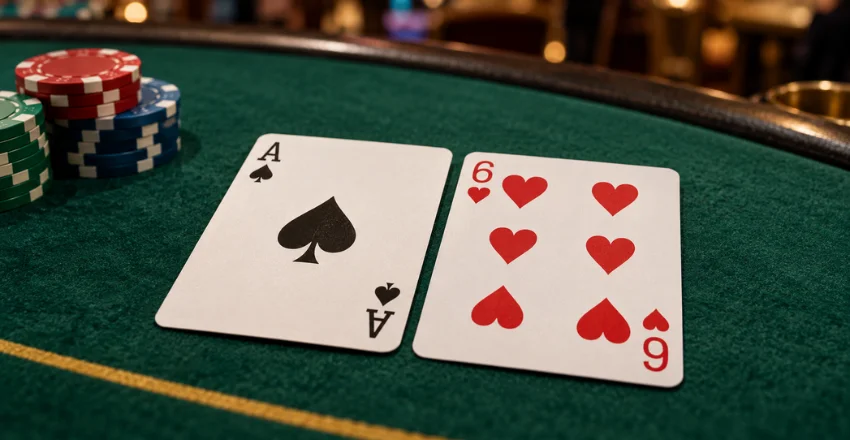
If you are asking what is a soft 17 in blackjack, the answer starts with the Ace. A soft 17 totals 17 while counting an Ace as 11. The most common example is Ace-6. That flexible Ace makes the hand different from a hard 17. It also explains why blackjack tables have special dealer rules for this total. Understanding those rules helps you read the table correctly and follow basic strategy.
Soft 17 at a Glance
| Topic | Key point |
|---|---|
| Basic definition | A hand totaling 17, with an Ace counted as 11 |
| Common example | Ace-6 |
| Other examples | Ace-2-4, Ace-3-3, Ace-Ace-5 |
| Hard 17 examples | 10-7 |
| H17 rule | The dealer must draw another card. |
| S17 rule | The dealer must stand. |
| Player choice | Usually hit or double, depending on the dealer card |
| Main advantage | The Ace can change from 11 to 1 after another card. |
A soft 17 is a blackjack total of 17 containing an Ace valued at 11. Ace-6 is the simplest example. Because the Ace can fall to 1, another card cannot immediately bust the hand.
Key Takeaways
- “Soft” means an Ace is still being counted as 11.
- Ace-6 is the easiest example to recognize.
- H17 means the dealer hits this total.
- S17 means the dealer stands on all 17s.
- S17 rules are generally more favorable to players.
- Players normally should not stand on Ace-6 under standard basic strategy.
- Exact strategy can change with deck count and other table rules.
What Is a Soft 17 in Blackjack?
A soft total contains an Ace that can still count as either 1 or 11. With Ace-6, the Ace counts as 11 to produce 17. If another card makes the total exceed 21, the Ace can fall to 1. For example, suppose you have Ace-6 and draw a 10. The Ace changes to 1, creating a hard total of 17. You stay in the hand instead of busting.
Multi-card hands can qualify too. Ace-2-4 totals 17, with the Ace still worth 11. Ace-3-3 works the same way.
Soft 17 vs. Hard 17
A hard 17 has no Ace valued at 11. A 10 and 7 form the clearest example. Taking another card can easily push that hand beyond 21. The flexible total behaves differently because its Ace protects against busting on the next draw. That difference matters for both dealers and players. It is why the same numerical total can produce different strategy decisions.
| Feature | Soft total of 17 | Hard 17 |
|---|---|---|
| Typical example | Ace-6 | 10-7 |
| Ace counted as 11. | Yes. | No |
| Can the next card immediately bust? | No | Yes. |
| Typical player approach | Hit or double | Stand |
| Special dealer rule | Yes. | Dealer already stands |
A beginner can remember the distinction by checking the Ace first. If an Ace can remain 11, the hand is soft. If every Ace must count as 1, the hand is hard.
Why Dealer H17 and S17 Rules Matter
U.S. blackjack tables may state that the dealer “hits soft 17” or “stands on all 17s.” H17 tells the dealer to draw another card. S17 requires the dealer to stand on a soft 17 total. The difference affects long-run game mathematics. Wizard of Odds calculates that changing from S17 to H17 reduces the player’s expected return by about 0.22 percentage points. That makes S17 the preferable rule when two otherwise identical tables are available.
The reason is straightforward. A dealer forced to stand keeps a relatively weak total of 17. An H17 dealer gets another opportunity to reach 18, 19, 20, or 21. Dealer probabilities also change under the two rules. Wizard of Odds publishes separate U.S. probability tables for H17 and S17 games. Those calculations show why the rule deserves attention before play begins.
How Should a Player Handle Ace-6?
The correct player move depends on the dealer’s visible card and the table rules. In common multi-deck basic strategy, players usually double Ace-6 against a dealer 3 through 6. Against other upcards, the usual play is to hit.
| Dealer upcard | Common basic-strategy action |
|---|---|
| 2 | Hit |
| 3 | Double if allowed; otherwise hit. |
| 4 | Double if allowed; otherwise hit. |
| 5 | Double if allowed; otherwise hit. |
| 6 | Double if allowed; otherwise hit. |
| 7 | Hit |
| 8 | Hit |
| 9 | Hit |
| 10 | Hit |
| Ace | Hit |
Standing may feel safer because the displayed total is already 17. Basic strategy does not treat the flexible hand like a hard 17. Its ability to take another card without busting immediately changes the calculation. Rule details still matter. Deck count, doubling restrictions, surrender rules, and dealer procedures can alter some strategy decisions. Use a chart designed for the exact game you are playing.
How to Identify the Rule at a U.S. Blackjack Table
Look at the table felt, placard, or digital game information before placing a wager. You may see wording such as “Dealer Must Hit Soft 17.” Another table may say “Dealer Stands on All 17s.” Don’t assume every blackjack game in one casino uses identical rules. Different tables can have different payouts, deck counts, and dealer procedures. Online versions can also use separate rule sets.
Table rules matter more than the casino game’s name alone. Blackjack payout terms deserve similar attention, especially whether blackjack pays 3:2 or 6:5. Wizard of Odds lists 6:5 payouts as a much larger negative rule change than H17. Readers who want to practice casino mechanics without wagering can also review StakeMag’s coverage of free casino games with virtual coins.
The page discusses free-play versions of games, including blackjack. Practice can help you recognize totals before you play for real money.
Examples That Make the Rule Easier to Remember
Ace-6 is the standard example because 11 plus 6 equals 17. If you draw a 4, the total becomes 21. If you draw a 10, the Ace becomes 1, and the total remains 17. Ace-2-4 follows the same logic. The Ace counts as 11 because 11 plus 2 plus 4 equals 17. A large next card can force the Ace down to 1.
Ace-Ace-5 also qualifies. One Ace can count as 11, and the other as 1. Together with the 5, the cards total 17. These examples show why memorizing only Ace-6 can be misleading. The key feature isn’t the number of cards. The deciding factor is whether one Ace can remain valued at 11.
Common Mistakes With This Hand
One common mistake is treating every 17 the same way. Players learn that standing on hard 17 is standard, then apply that rule to Ace-6. The two hands have different risk profiles. Another mistake is ignoring the dealer’s table rule. H17 and S17 can look like small print. They still change the game’s mathematical value.
Players can also rely on a strategy chart built for different rules. A single-deck game may require different decisions than a six-deck shoe. Always match your chart to the table conditions.
StakeMag also covers broader casino-game mechanics in its guide to playing 777 Strike. Different casino games use different rule structures. Checking those rules first is a useful habit across game types.
Does Understanding the Rules Guarantee Better Results?
No blackjack rule or strategy can guarantee a winning session. Basic strategy is designed to make mathematically efficient decisions over repeated play. Short-term results still depend heavily on random card outcomes. Following the correct play also does not remove the casino’s built-in advantage. It can reduce avoidable mistakes and help you compare table conditions. It cannot turn blackjack into a risk-free activity.
For U.S. readers, gambling rules and availability vary by state and operator. Only use legal, regulated games where you meet local age requirements. Set a spending limit before playing and treat gambling as entertainment.
If gambling stops feeling manageable, support is available nationwide. The National Council on Problem Gambling lists 1-800-MY-RESET as its current national helpline. Its network offers phone, text, and chat support nationwide.
Check the Rule Before You Play
Learning this concept gives you one simple table-reading advantage. Check whether the dealer uses H17 or S17 before choosing a blackjack game. Then use a basic strategy that matches the exact rules. You can also build familiarity through free-play games before risking money. StakeMag’s free casino games overview offers a starting point for practice options. Keep wagers within a fixed entertainment budget whenever real money is involved.
Frequently Asked Questions
What is a soft 17 in blackjack?
It is a total of 17, which includes an Ace counting as 11. Ace-6 is the most common example. The Ace can become 1 after you draw another card, if needed.
Does a player hit or stand on Ace-6?
Under common multi-deck basic strategy, standing is usually not recommended. Players generally double against dealer 3 through 6 and hit otherwise. Check the exact chart for your table rules.
What does “dealer hits soft 17” mean?
It means the dealer must draw another card while holding a soft 17. This rule is commonly abbreviated as H17. S17 means the dealer must stop instead.
Is H17 or S17 better for the player?
S17 is generally the more favorable rule when all other conditions match. Hitting gives the dealer another opportunity to improve the hand. The estimated difference is about 0.22 percentage points in expected player return.
Can Ace-2-4 count as 17?
Yes, because the Ace can count as 11. Adding 11, 2, and 4 produces 17. That makes the hand soft until circumstances force the Ace to become 1.