



Learning how to deal blackjack starts with mastering a fixed sequence rather than dealing cards quickly. You collect bets, distribute cards, manage player decisions, complete the dealer hand, and settle wagers. Once that order becomes automatic, running a smooth game becomes much easier.
| Key point | What a new dealer should know |
|---|---|
| Main goal | Run each hand accurately and consistently. |
| Card values | Number cards use face value; face cards equal 10. |
| Ace value | 1 or 11, depending on the hand |
| Initial deal | Two cards per player and two for the dealer |
| Player actions | Hit, stand, double, split, and sometimes surrender. |
| Dealer rule | Usually draw through 16 and follow the table’s 17 rule. |
| Standard win | Usually pays 1:1 |
| Natural 21 | Often pays 3:2, although some tables use 6:5 |
| Insurance | Usually pays 2:1 when the dealer has a natural 21. |
| U.S. rules | Procedures and wagering laws vary by casino and state. |
Direct answer: To deal blackjack, take wagers before distributing two cards to each active position and the dealer. Complete every player’s hand in order, reveal the dealer’s hidden card, follow the table’s drawing rules, compare totals, settle wagers, and clear the cards before starting the next round.
What You Need Before Dealing
You can practice the basic procedure with one or more standard 52-card decks. You also need chips or substitutes, a flat playing area, and something for discarded cards. A dealing shoe is useful for multi-deck practice but is not essential. Learn the card values before worrying about speed or presentation. Cards two through ten keep their printed values, while face cards count as ten.
An Ace counts as either one or eleven when calculating a hand. The goal is to beat the dealer’s total without exceeding 21. A two-card Ace and ten-value card creates a natural 21. Other combinations reaching 21 are ordinary 21-point hands rather than naturals.
Practice without money while learning the sequence. StakeMag’s guide to free casino games with no download explains how free-play formats can help beginners learn game mechanics. Using play chips at home also lets you repeat dealer procedures without financial pressure.
How to Deal Blackjack in 7 Steps
The easiest approach is to follow the same order every round. Professional procedures vary by casino, so local house rules always take priority. For home practice, these seven steps provide a clear foundation.
1. Prepare the Table and Accept Bets
Shuffle the cards and place them where you can draw consistently. Assign each player a defined betting position before the round begins. Wait until all permitted wagers are complete before dealing any cards. Once the betting period closes, avoid allowing ordinary wagers to change. That keeps the action clear and prevents disputes about when a bet was made.
Casino employees should follow their property’s specific betting and security procedures.
2. Deal the Opening Cards
Start with the first active player position and move across the table consistently. Give one card to each active hand before dealing yourself a card. Repeat that sequence so every participant receives a second card. At many shoe games, player cards are dealt face up. The dealer commonly receives one visible card and one hidden card in U.S.-style games. Exact procedures can change with the game type and casino rules.
Keep the cards separated enough for every hand to remain readable. Clear presentation makes totals easier to verify and reduces avoidable mistakes. Accuracy should come before dealing speed during practice.
3. Check for a Possible Dealer Natural
A visible Ace or ten-value card may require a dealer check under common U.S. procedures. With an Ace showing, insurance may also be offered before the check. The exact sequence depends on the property’s rules. If the dealer has a natural 21, most ordinary hands end immediately. Player naturals usually push against a dealer natural instead of winning.
Other unresolved wagers are then settled according to the table rules. European-style procedures can handle the dealer’s second card differently. Never assume every version follows the same checking process. Read the posted rules before running or joining an unfamiliar game.
4. Complete Each Player Hand
Handle one player position completely before moving to the next. Players may usually hit, stand, double, or split when their cards qualify. Some tables also allow surrender under specified conditions. A hit gives the player another card. A stand ends that player’s decisions for the hand. Continue giving cards after hits until the player stands or exceeds 21.
A double generally requires an additional wager and gives one final card. A split separates an eligible pair into two hands with another wager. House rules determine which pairs qualify and whether further splitting is allowed. Watch for clear hand signals at casino-style tables. Physical signals provide a visible record of a player’s choice for staff and surveillance. In a casual home game, verbal decisions may be enough.
5. Reveal and Play the Dealer Hand
After every surviving player finishes, turn over the dealer’s hidden card. Add the cards carefully before taking another card. The dealer does not choose actions based on personal strategy. Dealers normally draw on totals of 16 or lower. Hard 17 and higher normally stand. The key variation involves a soft 17 containing an Ace counted as eleven.
Some tables require another card on soft 17, while others require a stand. StakeMag explains that difference in its guide to soft 17 dealer rules. Check the table sign or written house procedures before the first hand.
6. Compare Hands and Settle Bets
Settle losing wagers and winning wagers in a consistent order. A player wins when their surviving total exceeds the dealer’s total without passing 21. A surviving player also wins when the dealer busts. Ordinary wins generally pay even money, or 1:1. A natural pays 3:2, although some games advertise a less favorable 6:5 payout. Always use the payout printed for the specific table.
A tied total is called a push. The original wager remains with the player rather than receiving a profit. Insurance commonly pays 2:1 when the dealer holds a natural. Practice payout calculations before trying to run fast rounds. Miscounted chips can cause more trouble than slow dealing. Clean chip stacks also make every payment easier to verify.
7. Clear the Cards and Start Again
Collect completed hands only after all results have been settled. Keep used cards separate from cards still waiting to be dealt. Then confirm that the table is ready before accepting the next round’s wagers. Casino procedures may specify exactly how cards enter a discard rack. They may also regulate shuffling, cutting, burning cards, and changing dealers. Follow those procedures when dealing professionally.
For casual practice, consistency matters more than copying every casino-floor motion. Repeat the same sequence until you rarely need to stop and remember the next action. Speed will improve naturally as the procedure becomes familiar.
How to Handle Splits, Doubles, and Insurance
Special actions create many beginner mistakes. The safest approach is slowing down and completing each transaction before dealing another card. Keep additional wagers visually separate until you have confirmed their amount. For a split, separate the original pair into two clear hands. Match the required additional wager before continuing either hand. Complete each split hand according to the house procedure.
For a double, confirm the extra wager before supplying the final card. The player normally receives exactly one additional card after doubling. Rules on doubling after splits can differ between tables. Insurance appears when the dealer shows an Ace under common procedures. It is a separate wager on whether the dealer has a natural. Do not confuse that side wager with the player’s original hand.
Common Beginner Dealer Mistakes
New dealers often focus too much on speed. Fast dealing has little value when totals, wagers, or player decisions are handled incorrectly. Build a repeatable routine before increasing the pace. Another mistake is changing the order between rounds. A fixed sequence makes unusual situations easier to manage. It also helps everyone at the table follow the action.
Some beginners assume every table uses identical rules. Soft-17 requirements, natural payouts, surrender, deck counts, and splitting restrictions can differ. Reading the posted rules prevents assumptions from becoming errors. Chip handling deserves separate practice too. Learn common 1:1, 3:2, and 2:1 calculations before running a busy game. Accurate payments protect both the dealer and the players.
Dealing at Home vs. Dealing in a Casino
A home dealer can simplify many professional procedures. Friends may use verbal decisions, play chips, and a single deck while learning. The essential goal is keeping every round fair and understandable. Professional casino dealing includes additional security requirements. Properties may specify hand clearing, chip placement, card positioning, shuffling methods, and supervisor calls.
Dealer-school instruction should take precedence over informal home methods. Casino wagering laws also vary across the United States. A legal activity in one jurisdiction may be restricted elsewhere. StakeMag’s Florida online casino guide shows how state-specific rules can affect available gaming formats.
Anyone hosting gambling involving real money should check applicable local laws first. An instructional home game using play chips avoids many gambling-related concerns. Casino employees should follow both legal requirements and employer procedures.
How to Practice Dealer Skills
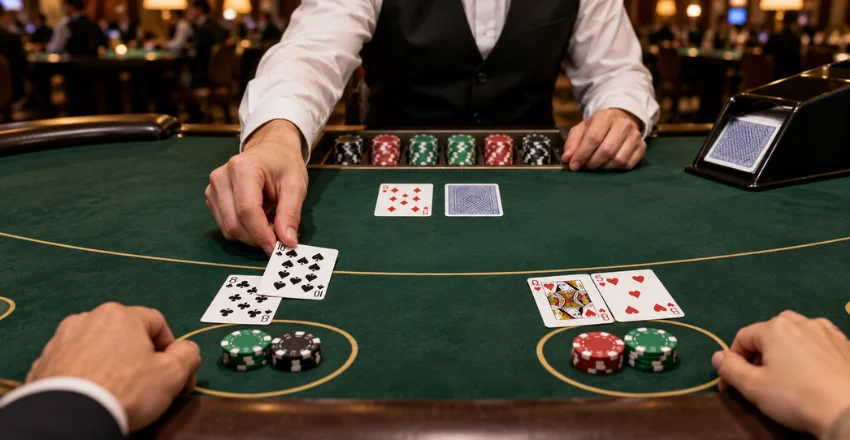
Start by running simulated rounds without players. Place several imaginary hands around the table and deal each round from beginning to settlement. This isolates the sequence before adding conversation and interruptions. Next, invite friends to make different decisions on purpose. Ask them to create splits, doubles, busts, pushes, and dealer-natural situations.
Repeating unusual outcomes makes them feel routine later. Practice counting totals separately from dealing. You should recognize common totals quickly without sacrificing accuracy. Soft hands deserve extra attention because the Ace can change value. Finish with payout drills using play chips. Randomly create different wager sizes and calculate ordinary wins, naturals, and insurance payments.
Dealer confidence usually comes from repetition rather than rushing.
U.S. Players Should Check the Table Rules First
Table conditions affect both dealing procedures and player expectations. Check whether the dealer hits or stands on soft 17. Also verify the natural payout, deck count, and available player actions. Do not assume a familiar casino name guarantees identical rules across every table. Live, digital, tribal, commercial, and social formats may follow different conditions.
Read the displayed rules before wagering or dealing. Real-money gaming availability also depends on location. U.S. readers should use lawful options and meet applicable age requirements. Treat wagering as entertainment rather than a source of guaranteed income.
Frequently Asked Questions
How to deal blackjack for beginners?
Start by accepting wagers and giving two cards to each active hand. Complete each player position before playing the dealer hand. Finish by comparing totals, settling wagers, collecting cards, and beginning a new round.
Does the dealer give cards clockwise?
The direction depends on the table layout and house procedure. What matters most is using the required sequence consistently. Casino dealers should follow their employer’s training rather than inventing a personal order.
Does the dealer always stand on 17?
Dealers normally stand on hard 17. Soft 17 can require either a hit or stand. Look for H17 or S17 wording on the table rules.
What happens when the dealer goes over 21?
A total above 21 means the dealer busts. Remaining player hands normally win unless they already busted earlier. Winning ordinary wagers are then paid under the table’s payout rules.
What does a natural pay?
Many tables pay a natural at 3:2. Some games use a 6:5 payout instead. Check the posted payout because this rule can materially change the game.
Can I practice dealing without gambling?
Yes, and practice chips are a useful starting point. You can learn card order, totals, hand signals, and payouts without risking money. Free digital versions can also help reinforce basic game flow.
Build Accuracy Before Speed
Knowing how to deal blackjack is mostly about learning a dependable sequence. Start slowly, keep hands and wagers organized, and check the applicable rules before each game. Repeated practice will make the mechanical parts faster without sacrificing accuracy. The best next step is running several complete rounds with play chips.
During practice, include splits, doubles, pushes, naturals, and soft dealer hands. Once those situations feel routine, ordinary rounds become much easier.