



What Is a Casino House Edge? A casino house edge is the mathematical advantage built into a casino game. It represents the casino’s expected share of wagers over long-term play. Understanding it helps you compare games without mistaking short-term luck for favorable odds. For example, a 2% edge means an average theoretical loss of $2 per $100 wagered. That does not mean every player loses exactly $2 after betting $100. Individual sessions can produce wins or much larger losses because results vary.
Casino House Edge at a Glance
| Term | What It Means |
|---|---|
| House edge | The casino’s mathematical advantage over the player |
| RTP | The theoretical percentage returned to players over time |
| 2% house edge | $2 theoretical loss for every $100 wagered |
| 96% RTP | Equivalent to a 4% edge under the same calculation basis |
| Expected loss | Total qualifying wagers multiplied by the applicable edge |
| Variance | How widely short-term results can differ from the mathematical average |
Direct Answer
The house edge shows how much a casino expects to retain from qualifying wagers over the long run. A 3% edge represents about $3 of theoretical loss per $100 wagered. It describes mathematical expectation across extensive play, not what will happen during one session.
How Does the Casino House Edge Work?
Casino games use rules and payouts that create a mathematical advantage for the operator. The advantage can be small or substantial depending on the game. Different bets within one game can also carry different percentages.
Roulette provides a straightforward example. A standard American wheel contains 38 pockets, including 0 and 00. Yet a straight-up winning number normally pays 35-to-1 rather than its true mathematical odds.
That difference creates the casino’s advantage. A New Jersey Division of Gaming Enforcement analysis states that standard Nevada and Atlantic City roulette has a 5.26% expected casino advantage on most wagers. The report also explains that this expected value is measured against handle, meaning the money wagered.
The principle appears differently in games such as blackjack. Rules, payouts, deck counts, and player decisions can all affect its mathematical expectation. This makes the specific rules important when comparing percentages.
How Do You Calculate Expected Loss?
The simplest calculation multiplies the applicable edge by the amount wagered. You must use the relevant total action for the calculation. Your original deposit alone does not measure how much money you have wagered.
Expected loss = amount wagered × house edge
Suppose you make forty $25 wagers during a session. Your total wagering action is $1,000, even if your starting bankroll was only $200. With a 2% edge, the theoretical expected loss equals $20.
This calculation describes an average across extensive repeated play. Your actual $1,000 of wagering could end with a profit instead. It could also produce a loss far exceeding $20.
Why Total Wagers Matter
Players often confuse bankroll with wagering volume. Imagine depositing $100 and repeatedly recycling winnings into new bets. Your cumulative wagers could eventually reach $1,000 without another deposit.
The mathematical advantage applies as qualifying bets are made. Faster games can therefore generate substantial wagering volume in a short period. Playing pace matters alongside the headline percentage.
House Edge vs. RTP: What Is the Difference?
Return to Player, usually shortened to RTP, describes theoretical returns from the player’s perspective. The edge describes the corresponding advantage from the casino’s perspective. Under equivalent measurement methods, the two percentages complement each other.
A game with 96% theoretical RTP has a corresponding 4% edge. Likewise, a 97.3% RTP corresponds to 2.7%. The basic relationship can be written as 100% − RTP = house edge.
This relationship is especially common when discussing slot games. Slots are often advertised using RTP instead of the casino’s advantage. Readers learning how reels and payouts operate can also review our 777 Strike slot guide before comparing paytables.
These percentages still represent long-term mathematical expectations. A 96% RTP does not promise $96 back from every $100 session. Short-term returns can differ sharply from that theoretical figure.
Typical House Edges for Popular Casino Games
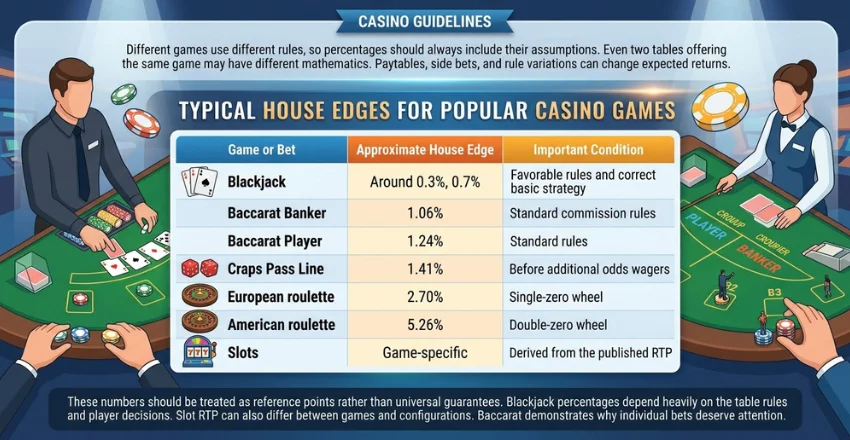
Different games use different rules, so percentages should always include their assumptions. Even two tables offering the same game may have different mathematics. Paytables, side bets, and rule variations can change expected returns.
| Game or Bet | Approximate House Edge | Important Condition |
|---|---|---|
| Blackjack | Around 0.3%, 0.7% | Favorable rules and correct basic strategy |
| Baccarat Banker | 1.06% | Standard commission rules |
| Baccarat Player | 1.24% | Standard rules |
| Craps Pass Line | 1.41% | Before additional odds wagers |
| European roulette | 2.70% | Single-zero wheel |
| American roulette | 5.26% | Double-zero wheel |
| Slots | Game-specific | Derived from the published RTP |
These numbers should be treated as reference points rather than universal guarantees. Blackjack percentages depend heavily on the table rules and player decisions. Slot RTP can also differ between games and configurations.
Baccarat demonstrates why individual bets deserve attention. The Banker and Player wagers have relatively close percentages under standard rules. The Tie wager can carry a much larger mathematical disadvantage.
Why Does the House Always Have an Edge?
Casinos do not need every player to lose every session. Instead, their games are structured around favorable long-term mathematical expectations. Large numbers of wagers allow those expectations to become increasingly important.
A roulette casino does not know where the ball will land on the next spin. It does know the probabilities across a large sample of spins. Its payout structure gives it an advantage across those repeated outcomes.
This distinction explains why winning streaks can happen without changing the mathematics. A player can leave ahead after ten spins or several hundred hands. That short-term result does not remove the built-in advantage.
Does a Lower House Edge Mean You Will Win?
A lower percentage does not make a casino game profitable for the player. It only means the theoretical cost of wagering is smaller under the stated assumptions. Random variation can dominate results during any realistic session.
Consider two games with 1% and 5% edges. The first has a lower expected long-term cost for equal wagering volume. Either game could still produce a winning or losing session.
This is where variance becomes important. Variance describes how widely results can move around their mathematical expectation. Games with similar theoretical returns can feel completely different because their payout patterns differ.
Can Strategy Reduce the Casino Advantage?
Strategy can affect games where player decisions influence mathematical outcomes. Blackjack is the best-known example because hitting, standing, splitting, and doubling affect expected value. Correct basic strategy can reduce avoidable mathematical mistakes.
Strategy cannot remove the underlying advantage from every casino game. Roulette betting systems do not change the probability structure of the wheel. Previous independent results also do not make a future color “due.”
Side bets deserve particular attention. They can have substantially different mathematics from the main game. Learning how betting odds work can also help readers distinguish probability from an advertised potential payout.
Why Rules and Payouts Matter
Small rule changes can produce meaningful mathematical differences. Blackjack paying 3:2 for a natural differs from a table paying 6:5. Roulette changes significantly when a second zero is added.
Paytables perform a similar function in video poker and other games. Two visually similar versions can produce different theoretical returns. Reading the rules therefore matters before relying on a published percentage.
For slots, check the game information screen when an RTP figure is available. The stated percentage describes theoretical long-term performance under its specified configuration. It should not be interpreted as a session-level promise.
House Edge Does Not Predict Your Next Bet
One common mistake is using long-term mathematics to predict an immediate result. The percentage describes expected performance across repeated wagering. It cannot tell you whether your next blackjack hand or roulette spin will win.
Another mistake is believing previous losses improve the next wager’s probability. Independent casino outcomes do not compensate players because they have experienced a losing streak. Increasing wagers to recover losses can instead increase the amount exposed to risk.
For U.S. players, treating gambling as entertainment rather than income provides a clearer framework. Set spending limits before playing and avoid using money needed for essential expenses. Stop when those limits are reached rather than chasing losses.
Why Understanding the Edge Matters
The percentage gives you a common measurement for comparing casino games and individual wagers. Without it, a large advertised payout can look attractive despite unfavorable underlying mathematics. The probability and payout must be considered together.
It also helps translate abstract percentages into dollars. A 5% advantage on $2,000 of qualifying wagers represents $100 of theoretical expected loss. That number can make the long-term cost easier to understand.
Playing speed should also be considered. Repeating smaller bets rapidly can generate more total action than placing larger bets slowly. The edge works alongside wagering volume, not separately from it.
Responsible Gambling and the House Edge
Knowing the mathematics does not create a guaranteed winning method. It gives you information about expected cost and risk. Casino games remain uncertain in the short term even when their probabilities are well understood.
Set a fixed entertainment budget before starting. Avoid borrowing money for gambling, and do not increase bets simply to recover earlier losses. Taking regular breaks can also help keep spending and time visible.
Players who want to understand game mechanics without wagering real money can explore free casino games first. Free-play results still should not be treated as evidence of future real-money outcomes. The underlying lesson remains that short-term results can vary.
The Bottom Line
Understanding the casino’s mathematical advantage helps you evaluate games using probabilities rather than winning streaks. Lower percentages generally mean lower theoretical costs when wagering volume and assumptions remain equal. They still cannot guarantee a profitable session.
Check the rules, payouts, RTP, and individual wager before comparing games. Remember that your total amount wagered matters more than your original deposit for expected-loss calculations. Treat the numbers as risk information rather than a prediction of your next result.
Frequently Asked Questions
What is a casino house edge in simple terms?
A casino house edge is the mathematical advantage a casino has within a game or wager. It estimates the casino’s long-term expected return from the relevant bets. It does not guarantee how one person’s session will finish.
Is house edge the same as RTP?
No, but the concepts are closely connected. RTP describes the theoretical return to players, while the edge describes the casino’s advantage. A 95% RTP generally corresponds to a 5% advantage under equivalent measurement assumptions.
What does a 5% house edge mean?
A 5% percentage represents $5 of theoretical expected loss for every $100 of applicable wagering. Actual short-term results can be much higher or lower. The calculation becomes meaningful across large amounts of repeated play.
Which casino games have a lower house edge?
Certain blackjack rule sets can produce relatively low percentages when correct strategy is used. Standard Banker baccarat and some craps wagers also have relatively low figures. Exact percentages depend on rules, payouts, and betting choices.
Can a betting system beat the house edge?
A betting progression does not change the underlying probabilities of independent casino outcomes. Changing bet sizes changes how much money is exposed. It does not turn a negative mathematical expectation into a positive one.
Does the casino house edge guarantee that I will lose?
No percentage guarantees the outcome of an individual session. Players can win because short-term results vary substantially. The mathematical advantage becomes more meaningful as repeated wagering accumulates over time.